SUCCESS STORY #6 | From Human Drivers to Trusted Automation: BERTHA’s Contribution to Human-Centred Mobility

As automated vehicles move closer to everyday deployment, a major challenge remains: understanding how they can interact safely and predictably with human road users. Alongside technological performance, the ability to account for the diversity of human driving behaviour is important for developing automated mobility that people can understand and trust.
Over the past three years, BERTHA has addressed this challenge by placing human behaviour at the centre of Connected, Cooperative and Automated Mobility (CCAM) research. At the heart of the project is a scalable, probabilistic Driver Behavioural Model (DBM), organised around four interconnected components: perception, risk awareness and decision-making, affective state, and motor control.
A major strength of this approach is that BERTHA does not treat human drivers as behaving in one uniform way. Research from AIT identified eight behavioural types, differentiated according to characteristics including risk tolerance, self-efficacy, efficiency, attention and interaction with other road users. The research also showed that the prevalence of these types differs between European countries, reinforcing the importance of representing behavioural diversity when developing and evaluating automated driving systems.
This behavioural understanding feeds directly into the DBM. For example, BERTHA’s cognition component combines risk awareness with decision-making, allowing different driving styles to accept different levels of risk and select different manoeuvres accordingly. The approach was developed and assessed across traffic situations including pedestrian crossings, left turns involving cars and bicycles, highway merging, cut-ins and collision avoidance.
Seeing the road through the driver’s eyes
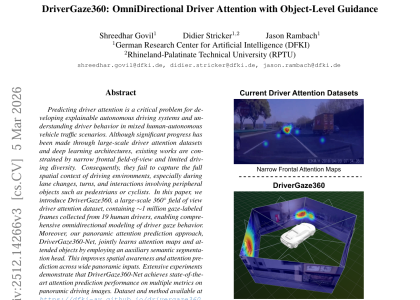
One of BERTHA’s most visible scientific results is its Perception Module. Driver attention is particularly important because conventional approaches often focus on a narrow frontal field of view, despite driving situations requiring attention to vehicles, pedestrians and cyclists across the surrounding environment. BERTHA therefore developed DriverGaze360, a large-scale omnidirectional driver-attention dataset, together with DriverGaze360-Net, a panoramic approach that jointly predicts attention maps and attended objects. The work underwent peer review and was published at CVPR 2026, while the dataset and code were made publicly available.
From real driving observations to reusable virtual scenarios
BERTHA has also developed methods to turn real-world driving observations into assets that can support virtual testing. Work led by Computer Vision Center (CVC) explored how real-world driving videos can be transformed into simulation-ready traffic scenarios, helping bridge the gap between on-road observations and virtual validation. The resulting research was accepted at IEEE ITSC 2026 (doi: 10.48550//arXiv.2606.21993).
This work builds on CVC’s broader role within BERTHA in CARLA scenes, adaptation of the DBM to CARLA, behaviour cloning and simulation integration, strengthening the connection between behavioural evidence collected from real drivers and reproducible virtual environments. This connection is particularly important for BERTHA’s wider validation approach. The project’s methodology brings human experiments, behavioural models, CARLA simulations, driving databases and real-world/test-track activities into the same workflow, with the HUB serving as the central environment connecting these resources.
Scaling up simulation and validation
To make this research usable beyond individual experiments, BERTHA developed the HUB, an environment designed to integrate behavioural models, simulation execution, scenario generation and data management. The HUB addresses a practical challenge in automated-driving research: running large numbers of simulation configurations while maintaining reproducibility and traceability. It supports local and cloud execution and can scale simulation tasks through a containerised architecture. The HUB also incorporates the Adaptive Refinement and Iterative Scenario Engineering (ARISE) framework, which converts natural-language descriptions into executable traffic scenarios and uses an iterative Test-and-Repair Loop to reduce manual intervention. Within BERTHA, ARISE provides a scalable scenario-definition component for the HUB and supports the generation of executable, semantically consistent scenarios for simulation-based testing. The work was accepted at IEEE IV 2026 (doi: 10.48550/arXiv.2601.14743; 10.48550/arXiv.2601.13218)
From simulation to a real vehicle
BERTHA then took an important additional step: assessing whether the DBM could contribute to automated-driving and ADAS applications both in simulation and in a real demonstrator.
More than 1,200 simulated runs were carried out across five safety-critical use cases, four risk levels, three road-surface conditions and different DBM driving styles, using regulatory and newly developed performance indicators. In the pedestrian-crossing scenario, for example, all three DBM styles began braking 0.40 to 0.93 seconds earlier than the reference ADAS, while the cautious DBM achieved a minimum time-to-collision of 2.63 seconds versus 1.87 seconds for the reference system in the low-risk configuration.
The research was not limited to virtual testing. The same DBM software was deployed on a Kia EV6 demonstrator, where an onboard computer used the model to command steering and adaptive-cruise functions during closed-track testing.
Together, these activities demonstrate a clear progression from understanding human behaviour, to modelling it, integrating it into simulation, and assessing how the resulting approaches can interact with real automated-driving technologies. BERTHA’s results should not be interpreted as proof by themselves of improved road safety, but they provide concrete evidence and tools that can contribute to future testing and development.
Trust depends not only on technology, but on behaviour
BERTHA’s human-centred approach also examined how people respond to different automated-driving behaviours. The results showed that automated driving style matters. Participants consistently distinguished between the three driving styles tested, and the ranking was maintained across sites, situations and driver types. Particularly revealing was the difference between occupants and other road users: in test-track experiments, cautious automated behaviour was rated similarly from inside the vehicle and from the roadside, whereas assertive behaviour received ratings 14 points lower from the pedestrian perspective.
At the same time, BERTHA’s findings highlight the need for caution when translating human behaviour directly into automated-driving design. Driver type alone did not reliably predict acceptance, and the project concluded that the typology is currently more appropriate as a tool for recruiting and interpreting test participants than as a direct parameter for personalising vehicle behaviour.
These findings reinforce one of BERTHA’s central messages: human-centred automation requires more than reproducing how people drive. It also requires understanding which behaviours are acceptable, in which situations, and from whose perspective.
Building a foundation for future CCAM research
Taken together, BERTHA has created more than a single behavioural model. Its results form a connected portfolio spanning human driving data, driver typologies, perception and cognition models, simulation-ready scenarios, the BERTHA HUB, scalable simulation and data-management infrastructure, ADAS integration, real-vehicle demonstration and acceptance testing. The project itself brought together 14 partners from six countries over 36 months, creating a multidisciplinary bridge between human factors, artificial intelligence, simulation, vehicle technologies and road-safety research.
This portfolio also has relevance for the European evolution of automated-driving validation. At the Final Event, the European Commission’s Joint Research Centre highlighted the complementary role of behavioural models and regulatory performance models: realistic behavioural models can populate virtual tests with diverse road users, while normative performance models provide the benchmark against which automated-driving performance can be judged.
BERTHA’s legacy therefore lies in providing methods, datasets, models, simulation infrastructure and experimental evidence that future CCAM research can build upon. Publicly accessible results, together with reusable simulation and data-management approaches developed within the project, create concrete pathways for continued research beyond BERTHA. The project’s final communication activities similarly underline that its knowledge, methodologies, datasets, tools and scientific contributions are intended to continue supporting research, innovation and deployment activities after the project ends.
Key takeway
BERTHA has moved from the ambition of understanding and reproducing human driving behaviour to a associated set of developed and evaluated research assets spanning human data, behavioural modelling, perception and cognition, simulation, real-world scenario reconstruction, scalable testing, ADAS integration, real-vehicle demonstrations and acceptance research. Rather than claiming that these results alone make automated driving safer or universally trusted, BERTHA provides a stronger foundation for developing and evaluating automated systems that can account for the complexity and diversity of the people with whom they share the road.