
BERTHA Workshop at TRA 2026 Highlights Human-Centred Approaches to Autonomous Mobility
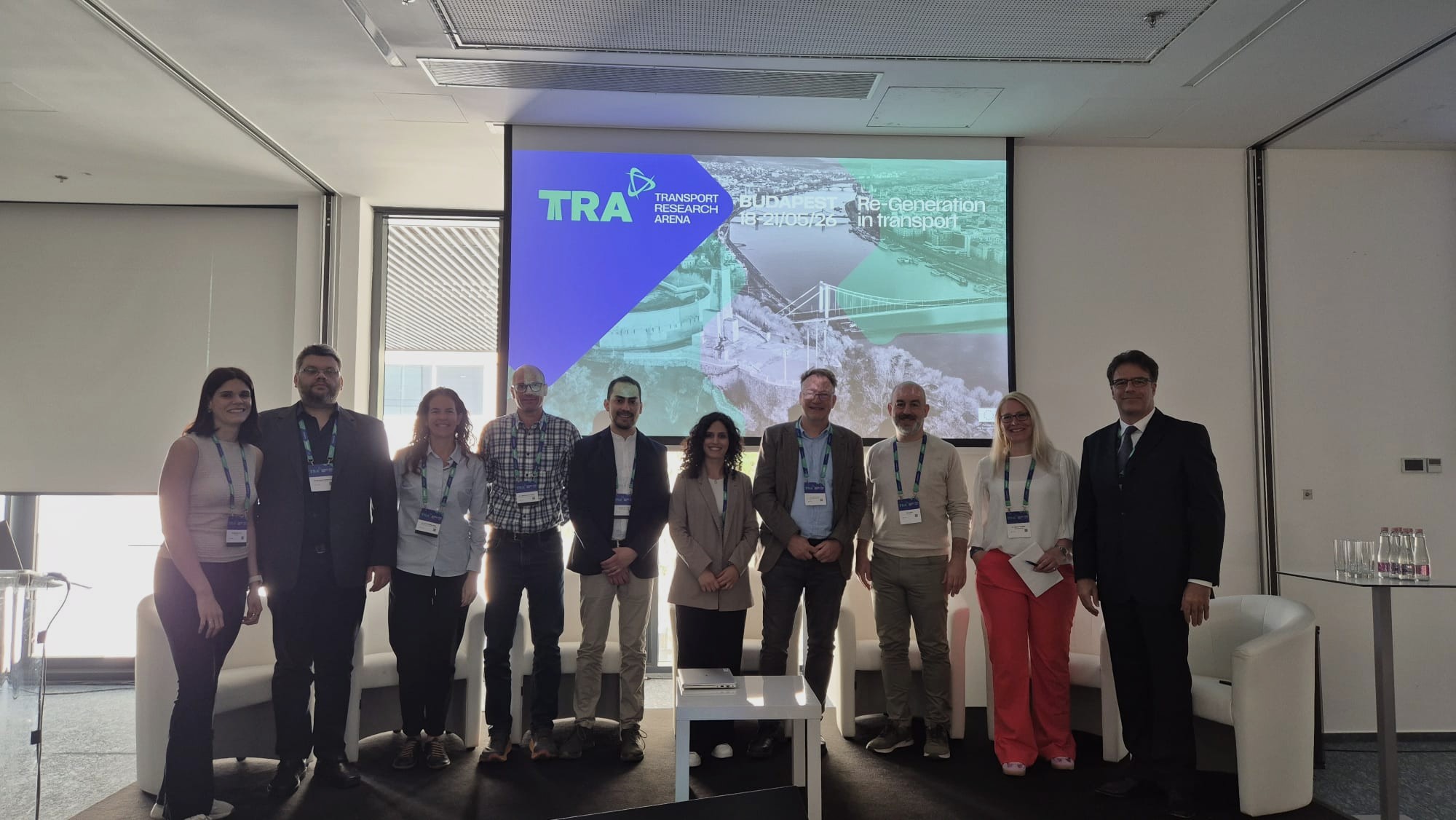
On 21 May 2026, the BERTHA project organised a dedicated workshop during the Transport Research Arena (TRA 2026) in Budapest, Hungary. The session brought together experts from research, industry and policy to discuss recent advances in human-centred autonomous driving, simulation-based validation, and smart transport systems.
Hosted at the Budapest Congress Center, the workshop formed part of the official TRA programme and provided a platform to present BERTHA’s results alongside complementary European initiatives and research efforts.
Advancing Human-centred Autonomous Driving
The workshop opened with a welcome by Sofia Oliveira and Marlene Faria (FI Group), who introduced the objectives of the session and set the scene for a forward-looking discussion on automated mobility.
Andrés Soler Valero (Instituto de Biomecánica de Valencia) then presented the BERTHA vision, emphasising the importance of human-centred approaches in the development of autonomous systems. His intervention highlighted how understanding driver behaviour and user interaction is key to ensuring trust, safety, and acceptance of automated vehicles.
Advancing Validation Through Scalable Simulation
A central theme of the workshop was the role of advanced simulation environments in enabling robust validation of automated driving technologies.
Eduardo Cervantes (Capgemini Engineering) presented BERTHA’s scalable, cloud-compatible simulation platform, designed to support efficient and large-scale testing of automated driving scenarios.
Complementing this, Konstantin Poddubnyy (DFKI) introduced the ARISE framework, focusing on adaptive scenario engineering and iterative refinement methods to improve testing accuracy and realism.
Together, these contributions demonstrated how simulation is becoming a cornerstone in accelerating innovation while ensuring safety and regulatory compliance.
Behavioural Modelling and Perception in Focus
Following a networking break, the workshop continued with insights into behavioural modelling and perception systems.
Johanna Tzanidaki (SAE Group Europe) shared perspectives from the HIDDEN project, illustrating how behavioural modelling enhances perception and decision-making in autonomous driving systems.
This session reinforced the importance of integrating human factors into the technological stack, bridging the gap between engineering and real-world user behaviour.
Smart Infrastructure and Digital Twins for Safer Mobility
The discussion expanded to infrastructure innovation with Zsolt Szalay (Budapest University of Technology and Economics), who presented how real-time digital twins and smart road systems are transforming transport networks, enabling safer and more efficient mobility ecosystems.
His contribution highlighted the growing convergence between vehicle intelligence and digital infrastructure, a critical aspect of future transport systems.
Interactive Debate and Key Takeaways
The workshop concluded with an audience Q&A, moderated by Martin Zach, where speakers and participants engaged in a dynamic exchange.
Looking Ahead
BERTHA’s participation in TRA 2026 showcased the project’s strong alignment with European priorities in safe, intelligent, and user-centric transport systems. By fostering collaboration between research, industry, and policy, the workshop contributed to shaping a shared vision for the future of automated mobility in Europe.