
BERTHA Joins Workshop on Human-Centric CCAM Technologies Hosted by HIDDEN project
BERTHA Contributes to Cross-Project Dialogue on Human-Centric CCAM
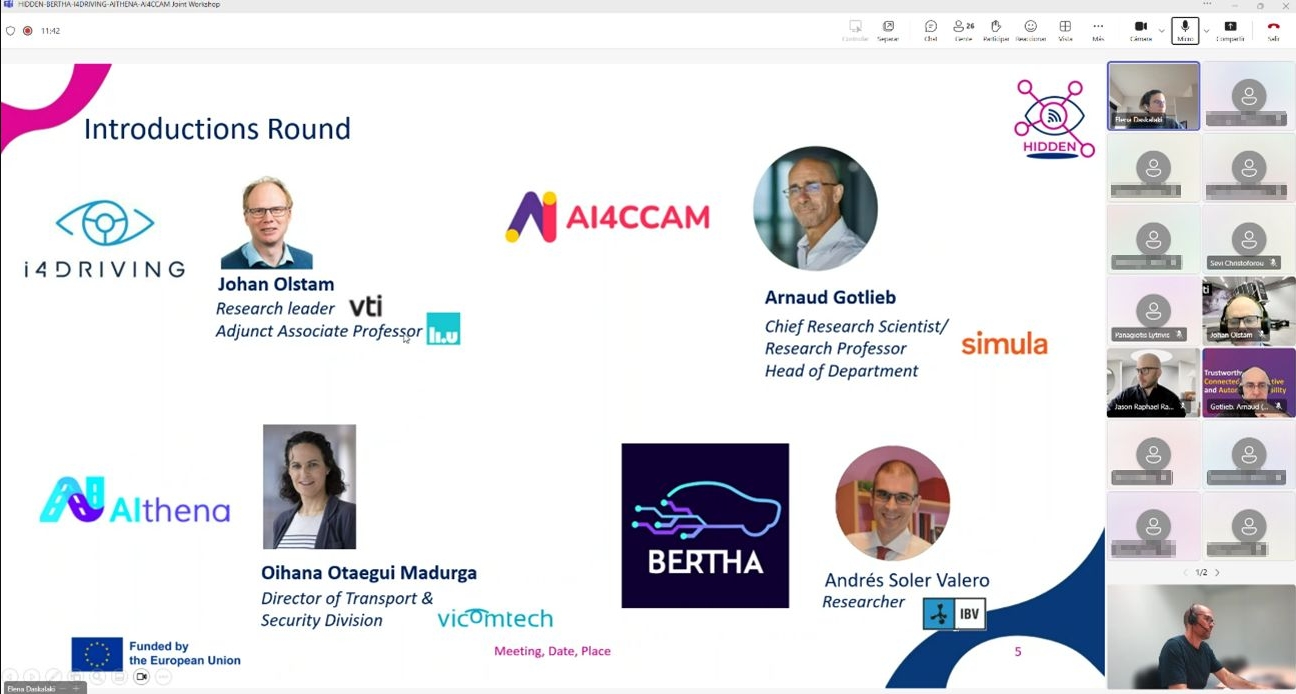
On 21 October, the BERTHA project participated in the online workshop on Human-Centric CCAM Technologies, hosted by the HIDDEN EU project. The event brought together four leading European initiatives – BERTHA, i4Driving, AIthena, and AI4CCAM – to exchange insights and align efforts in developing ethical, inclusive, and human-aware Connected, Cooperative and Automated Mobility (CCAM) systems.
Andrés Soler (Instituto de Biomecánica – IBV) and Jason Rambach (DFKI) jointly presented the BERTHA project, focusing on its development of a probabilistic Driver Behavioural Model. This model is designed to capture and interpret drivers’ physiological and emotional states in real time, enabling more adaptive and responsive automated driving systems.
Their presentation highlighted BERTHA’s interdisciplinary approach, combining biomechanics, artificial intelligence, and human factors research to ensure that future mobility solutions are not only technologically advanced but also human-centric and trustworthy.
Engaging in Cross-Project Dialogue on Trustworthy AI and Ethical Challenges
Following the presentations, BERTHA joined a roundtable discussion with representatives from i4Driving, AIthena, and AI4CCAM. The session explored key topics including:
- Driver behaviour modelling and simulation
- Trustworthy and explainable AI in CCAM
- Ethical dilemmas in automated decision-making
- Simulation environments for vulnerable road users (VRUs)
This exchange of knowledge and experience will support the HIDDEN consortium in defining its system requirements, final use cases, and the ethical and legal framework for its research.
Strengthening Europe’s Human-Centric CCAM Ecosystem
The workshop marked an important step in fostering collaboration across EU-funded CCAM projects. BERTHA’s participation underlines its commitment to advancing safe, inclusive, and ethically sound automated mobility, and to contributing to a shared European vision for human-centric innovation in transport.